
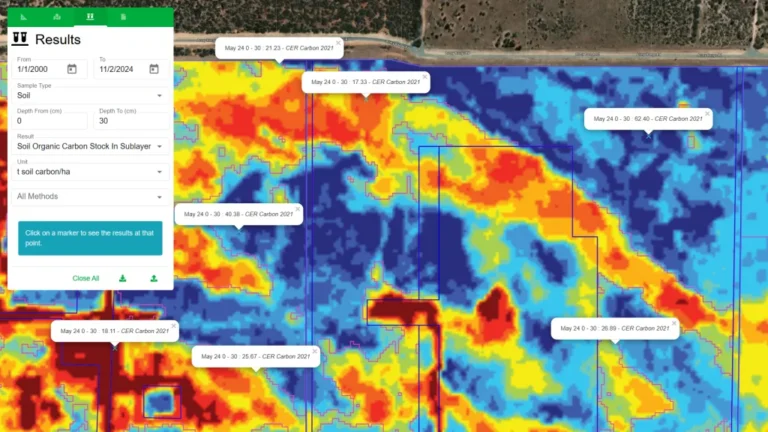
With significant advancements in our modeling of soil carbon in agriculture, we’re excited to share some of the next generation of developments aimed at understanding soil carbon dynamics using remote sensing. Recently, we discussed our work on developing carbon models using AI and Machine learning in The Australian article titled “AI in Agriculture? The Sky’s the Limit,”, with version 1.0 of these models being used to capture the variability of soil carbon stocks across diverse landscapes.

Figure 1. Validation of the ‘Zero Point’ carbon stock model is showing excellent correlation with on-ground samples, and observational data from photos. In the above image, blue = high carbon, red = low carbon and measured results being shown in the pop-up bubbles at locations
Version 2.0 of our work focuses on understanding the impact of farming practices over time. By leveraging an ever-growing database of samples (over 7,500 collected so far using FarmLab across Australia & shared with landowner permission), we’ve “seeded” the 2023-24 data layer, and this dataset allows us to look back in time and assess changes in soil carbon up until today.
“For corporations seeking to understand the sustainability of their supply chains, these models offer a way to visualize where regenerative agriculture and sustainable farming practices have been widely adopted, and to measure their impact.”
This enables remote tracking and management of practices, particularly in industries like sheep, cattle grazing, and dairy, which have traditionally faced challenges in monitoring practice-based impacts.

Figure 2. Remote sensing shows the change annually in soil carbon stocks over time across Kangaroo Island, one of the Australian government projects FarmLab is being used to detect soil carbon.
Work is currently underway developing the infrastructure to train and update the model, and it’s expected that FarmLab users will gain access to these in Q1 2025, whilst earlier implementation across government projects is currently underway at the time of this post.